
Today I’d like to talk about a sentence I hear weekly from friends and colleagues:
“I opened Claude, told it what to do, and 3 minutes later I had the working feature/website/app!”
Anytime I hear this and there’s a designer around, I can almost read it from their face: if design is now made by Claude in 3 minutes, then what am I doing here? What value do I add?
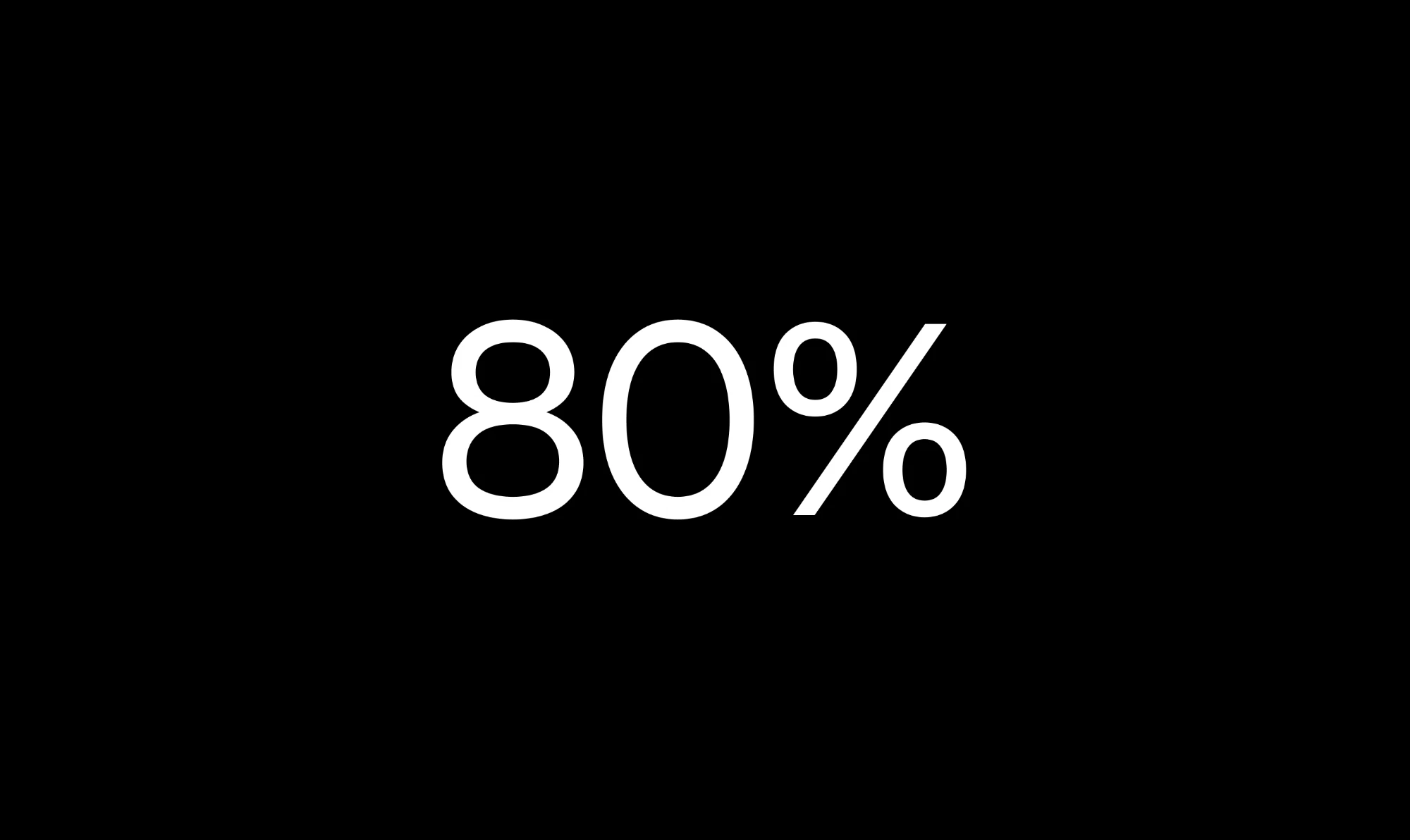
But see, the role of a designer was never to draw a UI. That is just how their work materialised, the path that leads to that UI is 80% of the job.
Julie Zhuo has a great piece written about this. In her recent weekly newsletter, a junior designer gets a scoped task: design a form that lets people edit their profile. The solution is already decided, the designer just has to draw it. The higher you go, the more abstract the problem gets: why would people want to update their profile at all? Is editing profiles even the right thing to focus on? At the highest level, you have to go out and find the problem yourself.
Claude is now very good at level one. Give it a clear brief and it’ll draw that form in minutes. But everything above it, figuring out what to build and why, is still on us. 80% of the job.
Designers provide value by understanding the essence of something before doing anything else
Arguably one of the best user experiences in today’s tech is provided by Apple. And according to Jony Ive, simplicity isn’t the lack of clutter, but understanding something so deeply that you can boil it down to its essence.
Claude will draw the UI in 3 minutes, it’s true. But it can only work with what you give it. If you didn’t spend enough time understanding the problem, the result might look impressive, but it likely won’t be effective.
“I think as much as anything it comes back to motivation and a sense of why are you doing this. Why is your first reaction not to run and go and understand glass and what you can do with glass? Why is your first reaction to start doing renderings of glass cups? I think it comes back to really where your heart is, really what it is that you want to do.”
— Jony Ive, in an interview with Deyan Sudjic
You can give a prompt to Claude and see the result in 3 minutes. But you can’t skip the hard work of deeply understanding the problem if you want the result to be the best it can be.
Designers provide value by bringing stakeholders along
To understand something deeply, you need to talk to people who know more about the topic than you do.
One of the values designers have held dear ever since digital UX design became a thing is that good design doesn’t happen in a vacuum. Sitting down alone with Claude can produce something that helps start conversations, but it won’t replace the need to get people involved, bring in their knowledge and experience, and make them feel like they are part of the solution.
One of the greatest values designers provide is facilitation: bringing people together to work on a problem and helping them land on the best possible solution, taking into account the widest possible range of views and knowledge.
Designing a workshop is a design challenge in itself: knowing what the outcome should be by the end of it, and how to navigate people there.
Designers provide value by making the invisible visible
To bring people along, you need to help them understand complex things in a simple way.
So much of what we work on in digital product design isn’t tangible. What journey does a user go through from the moment they have an idea to the moment they actually get where they want to be? What touchpoints and services do they need to interact with along the way? What emotions do they feel, and what tasks do they need to complete?
So much of what we do is making these invisible processes tangible: user journeys, flow charts, service blueprints.
Designers are great at synthesising complex things into easily understandable forms, so the people who need to give feedback and be brought along can follow.
Designers provide value by innovating
Once you’ve brought people together, helped them understand things simply, and made the invisible visible, you can help them innovate.
In a world where any piece of software can be copied in minutes, arguably one of the biggest advantages a business can have is innovation: making something no one has made before, solving a problem or providing value in a way no one else on the market has.
In his book The Art of Innovation, Tom Kelley shows how the team at IDEO innovates, and a key ingredient is simply listening to your users. Going out there, talking to people and seeing how they interact with the product is typically what researchers and designers do, and it informs the ideas and design decisions that lead to innovative solutions.
Designers provide value by envisioning the future
Once you’ve helped your stakeholders come up with innovative ideas, you can help them put them together into a vision.
“If you want to build a ship, don’t drum up the men to gather wood, divide the work, and give orders. Instead, teach them to yearn for the vast and endless sea.”
— often attributed to Antoine de Saint-Exupéry
It’s one thing to add 10 things to your product in a day and see what sticks, and another to have a vision of where your product is going and where you’ll be in a year.
Designers are great at creating a vision that unites people and gets them excited about the future, working towards a shared North Star.
Designers provide value by making a cohesive experience
Once you know what the future looks like, you can make sure it fits well into the greater puzzle.
This summer we stayed in an Airbnb in Croatia. It was prime time and everything was booked, but we found one that seemed to fit our needs, so we took it. The flat was a bit older and everything a bit outdated: old-school wallpaper on the walls, worn furniture. It had two bathrooms, and one of them was a big surprise when we first opened the door. It had a marble floor, white tiles, and light so strong you almost had to close your eyes when you went in. It was the complete opposite of the rest of the flat, almost as if someone had teleported it there from a million-dollar villa. It was a surreal experience.
If you’d A/B tested this bathroom against the other one, I probably would’ve said the marble bathroom is defo the winner. But looking at the entire experience, the entire flat, I actually preferred the other one, as it was more cohesive with the rest of the flat.
Designers are great at looking at the big picture and understanding the context when developing a new feature. That new feature needs to fit with the features around it, the screen itself, and the greater user journey.
Designers provide value by caring about the details
Once you’ve done all the hard work, you can finally draw the pixels.
Ten years ago I wrote a short piece asking what makes good design, if you had to answer in one word. My answer was care. So much around us testifies to carelessness, but if you do care, it is really conspicuous.
Claude can draw a decent screen in minutes. Decent is the default now. Which means care is more conspicuous than ever.
I still believe in people who are willing to pay the price of care. That part was never automated.